Knitting guide
Yarn weights explained: from lace to jumbo
Updated by Khokhar Sab
Yarn weight describes how thick a yarn is. The Craft Yarn Council numbers weights from 0 (lace) to 7 (jumbo), and each number comes with a typical gauge and needle or hook range. To substitute yarn, pick the same weight number, then check that your swatch matches the pattern's gauge and compare yards per gram.
What "weight" means for yarn
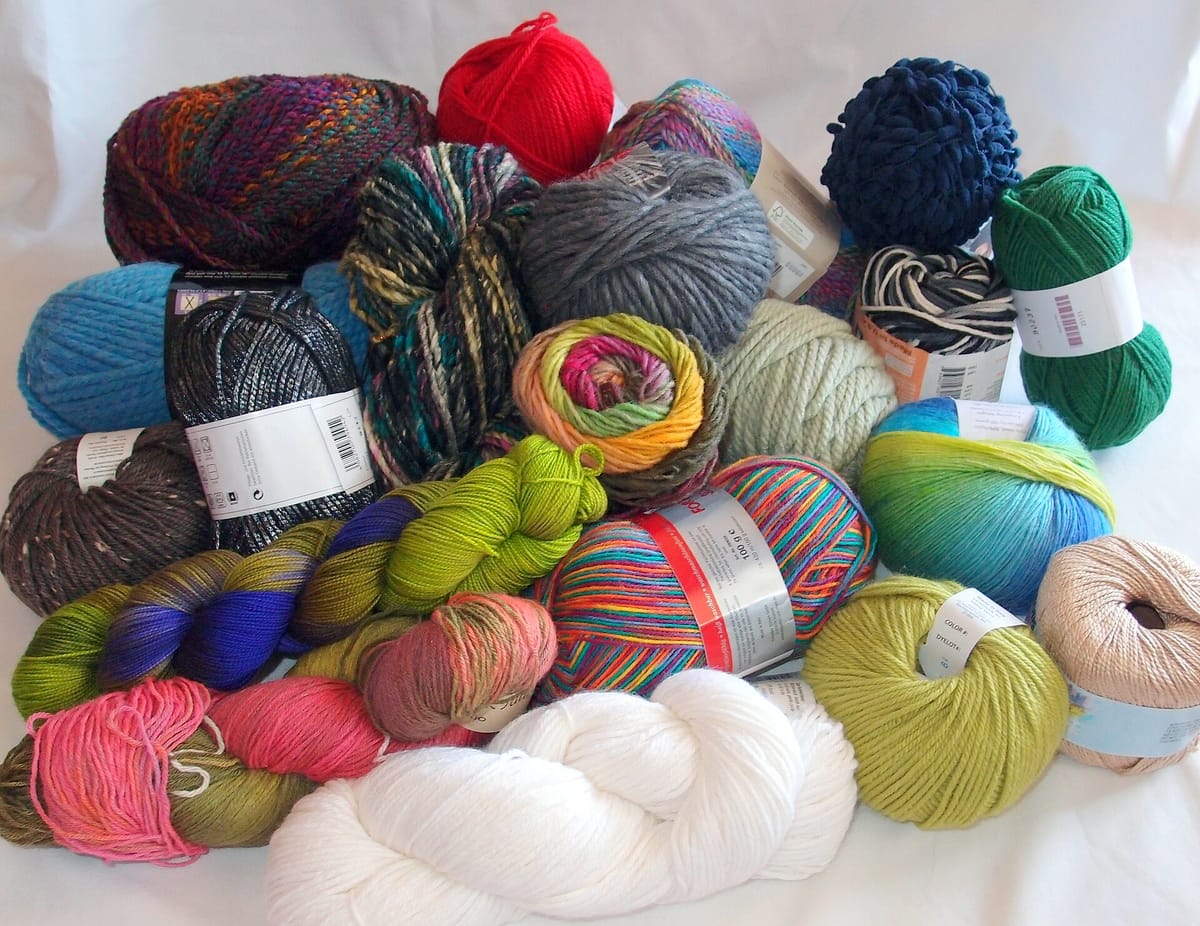
Despite the name, yarn weight measures thickness. How heavy a ball is doesn't come into it. A thicker strand makes bigger stitches, so it needs bigger needles or hooks and gives fewer stitches per inch. A thinner strand does the opposite.
Over the years, yarns picked up a lot of names: fingering, sport, DK, worsted, aran, chunky. Those names are still on labels and in patterns, but they don't always mean the same thing from one maker or country to the next. A numbered system gives everyone a shared scale.
The 0 to 7 numbering
The Craft Yarn Council's Standard Yarn Weight System splits yarn into eight groups numbered 0 to 7. Each group has a name, some common alternative names, and a typical range of gauges and tool sizes. The table below lists them, with knitting gauge given as stitches per 4 inches (10 cm) in stockinette.
| Number | Name | Also called | Knit stitches per 4 in | Needle (mm) | Hook (mm) |
|---|---|---|---|---|---|
| 0 | Lace | Fingering, 10-count crochet thread | 33 to 40 | 1.5 to 2.25 | Steel 1.4 to 2.25 |
| 1 | Super fine | Sock, fingering, baby | 27 to 32 | 2.25 to 3.25 | 2.25 to 3.5 |
| 2 | Fine | Sport, baby | 23 to 26 | 3.25 to 3.75 | 3.5 to 4.5 |
| 3 | Light | DK, light worsted | 21 to 24 | 3.75 to 4.5 | 4.5 to 5.5 |
| 4 | Medium | Worsted, afghan, aran | 16 to 20 | 4.5 to 5.5 | 5.5 to 6.5 |
| 5 | Bulky | Chunky, craft, rug | 12 to 15 | 5.5 to 8 | 6.5 to 9 |
| 6 | Super bulky | Super chunky, roving | 7 to 11 | 8 to 12.75 | 9 to 15 |
| 7 | Jumbo | Jumbo, roving | 6 or fewer | 12.75 and larger | 15 and larger |
The ranges overlap at the edges. A light (3) yarn knits at 21 to 24 stitches per 4 inches, and a medium (4) yarn at 16 to 20. A yarn near the border could suit patterns written for either one. The full figures, including US needle and hook sizes and crochet gauges, are on the yarn weight chart.
The common names, group by group
Here is what each group is usually called and what the chart lists it for. The "also called" names come straight from the same data as the table.
- 0, Lace: also called fingering, 10-count crochet thread. Used for shawls, doilies, fine lace. Crochet gauge for this group uses double crochet, and the hooks are steel (1.4 to 2.25 mm).
- 1, Super fine: sock, fingering, baby. Used for socks, light shawls, baby things.
- 2, Fine: sport, baby. Used for light sweaters, baby clothes.
- 3, Light: DK, light worsted. Used for garments, lighter blankets.
- 4, Medium: worsted, afghan, aran. Used for blankets, hats, sweaters, toys.
- 5, Bulky: chunky, craft, rug. Used for warm blankets, rugs, quick hats.
- 6, Super bulky: super chunky, roving. Used for chunky throws, cowls, fast projects.
- 7, Jumbo: jumbo, roving. Used for arm knitting, giant blankets.
Notice that some names appear in more than one group. "Fingering" sits under both 0 and 1, and "baby" under both 1 and 2. That is one reason the number is more reliable than the name when you shop or substitute.
What the weight does to your stitch count
The gauge column is easier to picture as a cast on. This table multiplies each group's knit gauge range by 5 to get the stitches for a piece 20 inches wide, such as a wide scarf or a sweater front. The numbers come from the same chart data as the table above.
| Weight | Knit stitches per 4 in | Stitches for 20 in |
|---|---|---|
| 0 Lace | 33 to 40 | 165 to 200 |
| 1 Super fine | 27 to 32 | 135 to 160 |
| 2 Fine | 23 to 26 | 115 to 130 |
| 3 Light | 21 to 24 | 105 to 120 |
| 4 Medium | 16 to 20 | 80 to 100 |
| 5 Bulky | 12 to 15 | 60 to 75 |
| 6 Super bulky | 7 to 11 | 35 to 55 |
| 7 Jumbo | 6 or fewer | 30 or fewer |
A super fine yarn needs 135 to 160 stitches for the same width that a bulky yarn covers in 60 to 75. That is why a pattern written for one weight can't simply be knit in another: every stitch count in it would be wrong. Even inside one group, the low and high ends differ by 20 stitches across 20 inches for a medium yarn. So the gauge in the pattern matters more than the number on the label.
Needle and hook sizes across systems
Each weight comes with a suggested tool range. For example, medium (4) yarn pairs with 4.5 to 5.5 mm needles (US 7 to 9) and 5.5 to 6.5 mm hooks (US I-9 to K-10½). These are starting points. The right size is the one that gets the gauge your pattern asks for.
Tool sizes have their own naming systems too. Millimeters are the clearest because they measure the tool directly. US needles use numbers, US hooks use letters with numbers, and older UK patterns use a different set of numbers. A 4 mm needle is US 6 and old UK 8. A 5 mm hook is US H-8 and UK 6. The knitting needle size chart and the crochet hook size chart list every size side by side.
Ply names: why "4 ply" doesn't mean four strands
In the UK and Australia, yarn is often named by ply: 2 ply, 4 ply, 8 ply and so on. A ply is one of the thinner strands twisted together to make the yarn. Sheep and Stitch's yarn weight guide points out that the name has drifted from the structure: a 4 ply weight yarn can have only 2 plies. Read ply names as weight names.
Sources don't agree on exactly where each ply name falls. Kirsten Holloway's yarn weights guide lists 4 ply under both super fine (1) and fine (2), and places 10 to 12 ply with medium (4). The yarn weight chart gives rough matches for 4, 8 and 10 ply. When a pattern names a ply, check its gauge before you pick a yarn.
How to identify a yarn with no label: wraps per inch
Stash yarn often loses its label. The Craft Yarn Council's page on how to measure wraps per inch (WPI) gives a quick test.
- Wrap the yarn around a pencil or anything else with an even thickness, for a few inches.
- Lay the wraps snugly side by side, with no gaps and no overlaps. Don't pull the yarn tight.
- Hold a ruler against the wraps and count how many fit in 1 inch.
- Count in two or three places, the way you would on a gauge swatch, and compare with the table.
| Weight | Wraps per inch |
|---|---|
| 0 Lace | 30 to 40+ |
| 1 Super fine | 14 to 30 |
| 2 Fine | 12 to 18 |
| 3 Light | 11 to 15 |
| 4 Medium | 9 to 12 |
| 5 Bulky | 6 to 9 |
| 6 Super bulky | 5 to 6 |
| 7 Jumbo | 1 to 4 |
The ranges overlap. A yarn with 12 wraps per inch could be a fine (2), a light (3) or a medium (4). The council warns that WPI is subjective and changes with how tightly you wrap, so treat it as a first guess. A swatch on the suggested needle settles it.
How to read a yarn label
A label packs a lot into a small space. Here is what to look for:
- The weight number, 0 to 7, often shown on a small symbol. Some labels give only a name such as "DK" or "worsted", in which case the table above helps place it.
- The length and weight of the ball, such as yards and meters per so many grams. You need both to compare yarns.
- A suggested gauge and needle or hook size. This is the maker's starting point, usually over 4 inches or 10 cm. Kirsten Holloway notes that a pattern's gauge takes priority over the label's, since the designer may have chosen a different needle on purpose.
- Fiber content. Wool, cotton, acrylic and blends behave differently, even at the same weight.
- Care instructions, which tell you how to wash the finished piece.
- A dye lot number. Balls from different lots can differ slightly in color, so buy enough from one lot for the whole project.
How to substitute one yarn for another
Swapping the yarn a pattern calls for works well if you check a few things in order. This is the short version. The full guide on how to substitute yarn adds fiber, yarn construction and holding two strands together.
1. Match the weight number
Start with a yarn in the same group. If the pattern was written for a medium (4) yarn, look at other 4s first. This gets you close, but it isn't enough on its own, because each group covers a range.
2. Match the gauge
Knit or crochet a swatch with the new yarn and measure it. If your gauge matches the pattern, the sizes in the pattern will hold. If it doesn't, change your needle or hook size and swatch again. The guide on how to measure gauge walks through this, and the gauge calculator can convert stitch counts if you choose to keep a different gauge.
3. Compare yards per gram
Two yarns of the same weight can be quite different in density. Divide the length on the label by its weight in grams to get yards per gram. A ball with 200 yards in 100 grams is 2 yards per gram; one with 220 yards in 100 grams is 2.2. A similar figure suggests a similar thickness.
It also helps you buy the right amount. Work out the total yards the pattern needs (its ball count times the yards per ball), then divide by the yards in one ball of your new yarn. Round up, and buy from a single dye lot.
Things that change how a yarn behaves
Weight is only part of the picture. Fiber and spinning also change how a yarn knits up. A cotton yarn has less stretch than a wool one of the same weight, which can matter for ribbing or fitted pieces. A fuzzy or brushed yarn can look thicker than its number suggests. A swatch in the actual yarn shows these effects before you commit to a whole project.
Packaging doesn't change a yarn's weight either. Kirsten Holloway points out that skeins, cakes and hanks can all hold the same weight of yarn, so read the label rather than judging by the shape of the ball.
When you're ready to pick a size, the yarn weight chart has the complete figures for every group, including crochet gauges and US tool sizes.
Sources and further reading
- Craft Yarn Council: Standard Yarn Weight System.
- Craft Yarn Council: how to measure wraps per inch.
- Sheep and Stitch: yarn weights explained.
- Kirsten Holloway: yarn thickness guide.
Video tutorial
"Yarn Weights EXPLAINED: Stop Guessing and Start Knitting Right" by Sheep & Stitch, on YouTube. The video loads only when you press play.