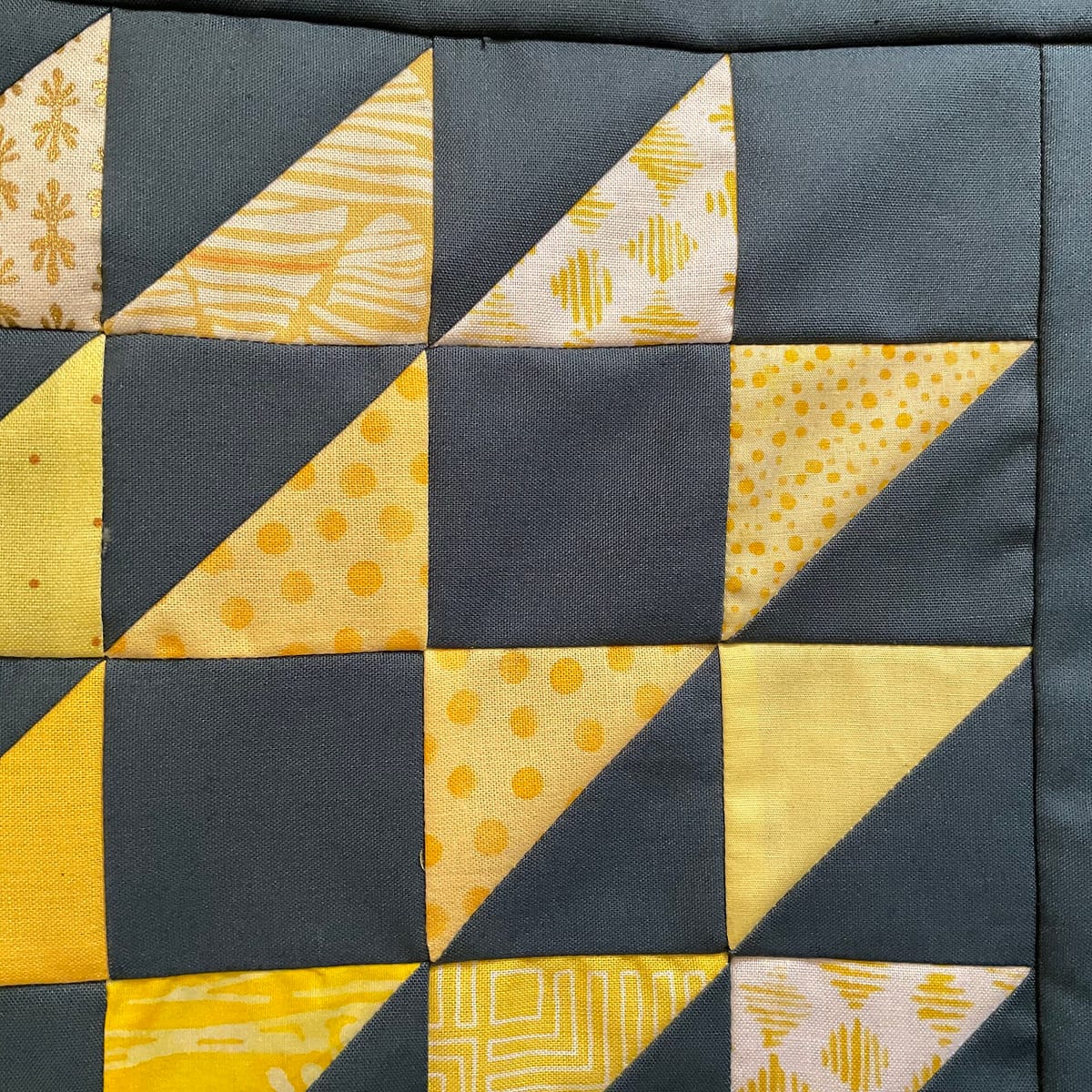
How to use the calculator
- Pick half-square triangles or flying geese, then the method you want to sew.
- Enter the finished size: the size each unit shows in the quilt. For flying geese, enter width and height; geese are usually twice as wide as they are tall.
- Enter how many units you need. The calculator rounds up to whole sets.
- For half-square triangles, choose exact cut sizes or cut bigger and trim. Check the fabric width, then read the cutting list and yardage for each fabric.
How the methods work
Two at a time. Place two squares right sides together, sew ¼ inch on each side of a drawn diagonal and cut apart on the line. Each pair makes two units with straight grain on the outside edges.
Four at a time. Sew two larger squares together all the way around the edge, then cut on both diagonals. It is quick, but the outer edges of every unit are on the bias, so press gently.
Eight at a time. Sew two squares about twice the size together on both sides of both diagonals. Then cut across the middle in both directions and along the diagonals.
Flying geese. One at a time sews a small square onto each end of a rectangle and trims the corners away. The four at a time method sews small squares to one large square in two rounds and wastes no fabric.
Formulas
- HST two at a time: finished + ⅞".
- HST four at a time: finished × 1.414 + 1¼", rounded up to ⅛".
- HST eight at a time: (finished + ⅞") × 2.
- Flying geese four at a time: one square finished width + 1¼", four squares finished height + ⅞".
- Flying geese one at a time: rectangle (width + ½") × (height + ½"), two squares height + ½".
Worked example: 48 half-square triangles
A pattern needs 48 HSTs that finish at 3 inches. Two at a time, each pair of squares makes 2 units, so you need 24 pairs: 24 squares of each fabric, cut 3 + ⅞ = 3⅞ inches.
From 40 inches of usable width, 10 squares of 3⅞ inches fit across a strip, so 24 squares take 3 strips 3⅞ inches wide. That is 11⅝ inches of each fabric, and with 10 percent extra the calculator suggests ⅜ yard of each. Made eight at a time instead, the same 48 units need just 6 squares of 7¾ inches from each fabric.
HST cut size chart
Exact cut sizes for each method. Add your trimming allowance if you like to square up.
| Finished HST | Unfinished | 2 at a time | 4 at a time | 8 at a time |
|---|---|---|---|---|
| 1½" | 2" | 2⅜" | 3⅜" | 4¾" |
| 2" | 2½" | 2⅞" | 4⅛" | 5¾" |
| 2½" | 3" | 3⅜" | 4⅞" | 6¾" |
| 3" | 3½" | 3⅞" | 5½" | 7¾" |
| 3½" | 4" | 4⅜" | 6¼" | 8¾" |
| 4" | 4½" | 4⅞" | 7" | 9¾" |
| 5" | 5½" | 5⅞" | 8⅜" | 11¾" |
| 6" | 6½" | 6⅞" | 9¾" | 13¾" |
Flying geese cut size chart
| Finished geese | Goose square (1) | Sky squares (4) | Makes |
|---|---|---|---|
| 3" × 1½" | 4¼" | 2⅜" | 4 geese |
| 4" × 2" | 5¼" | 2⅞" | 4 geese |
| 5" × 2½" | 6¼" | 3⅜" | 4 geese |
| 6" × 3" | 7¼" | 3⅞" | 4 geese |
| 8" × 4" | 9¼" | 4⅞" | 4 geese |
Flying geese sizes for sawtooth star blocks
Flying geese often go into star blocks. In a sawtooth star, each goose finishes half the block wide and a quarter of the block tall, so a 12 inch star uses 3 by 6 inch geese. A star needs four geese, which is one batch made four at a time.
| Star block | Geese finish | 4 at a time: goose square | 4 at a time: sky squares | 1 at a time: rectangle | 1 at a time: sky squares |
|---|---|---|---|---|---|
| 4" | 2" × 1" | 3¼" (1) | 1⅞" (4) | 2½" × 1½" | 1½" (2 per goose) |
| 6" | 3" × 1½" | 4¼" (1) | 2⅜" (4) | 3½" × 2" | 2" (2 per goose) |
| 8" | 4" × 2" | 5¼" (1) | 2⅞" (4) | 4½" × 2½" | 2½" (2 per goose) |
| 10" | 5" × 2½" | 6¼" (1) | 3⅜" (4) | 5½" × 3" | 3" (2 per goose) |
| 12" | 6" × 3" | 7¼" (1) | 3⅞" (4) | 6½" × 3½" | 3½" (2 per goose) |
Four at a time only works when the goose is exactly twice as wide as it is tall. All four geese come from the diagonals of one square. For other shapes, use one at a time. Sew the corners you trim off into small bonus HSTs, as the Scrapish flying geese tutorial suggests.
How these sizes compare with published charts
Two at a time and eight at a time charts agree almost everywhere: finished plus ⅞ inch, and twice that. Four at a time varies more. Sarah Maker's chart gives 5½ inch squares for a 3 inch HST, the same as this calculator.
For a side-by-side look at the methods, including bias edges and the fabric each one uses, read the half-square triangle methods guide.
Tips for accurate units
- For flying geese, the point of the goose should sit ¼ inch below the top raw edge, so the next seam passes just above it. Sew with the goose unit on top so you can see the point.
- Sew a test unit and measure it before cutting everything. If it comes out small, your seam is too wide.
- Press the seam before opening the unit to set the stitches, then press toward the darker fabric.
- Use a ruler with a 45 degree line to square up HSTs, lining the line up with the seam.
- Draw diagonal lines with a fine pencil or marker on the wrong side of the lighter fabric so they are easy to see.