How to use the fabric yardage calculator
- Enter how many pieces you need and their width and height. Tap "Add another size" for each different piece cut from the same fabric, up to six sizes.
- Choose whether your sizes mean cut sizes (seam allowance included) or finished sizes.
- Check the fabric width and the selvage trim. Quilting cotton is 42 to 44 inches wide; wide backing and some solids are wider.
- Set the extra percentage, and tick "Directional print" if the pieces must all stay the same way up.
How the yardage is worked out
Quilters usually cut a strip across the full width of the fabric, then cut that strip into pieces. So the calculator first works out how many pieces fit side by side across the usable width. That tells it how many strips you need, and the strips stacked together give the length of fabric.
For rectangles, it also tries the pieces turned sideways. A 12½ by 6½ inch rectangle fits 3 across a 40 inch strip one way and 6 the other way, and the second layout can use less fabric. If your print has a direction, mark it and the calculator keeps every piece upright.
Formulas
- Usable width = fabric width − selvage trim.
- Pieces per strip = usable width ÷ piece width, rounded down.
- Strips = number of pieces ÷ pieces per strip, rounded up.
- Fabric length = strips × piece height, added up for every size.
- Yards to buy = fabric length × (1 + extra %) ÷ 36, rounded up to ⅛ yard.
Worked example: charm squares for a quilt top
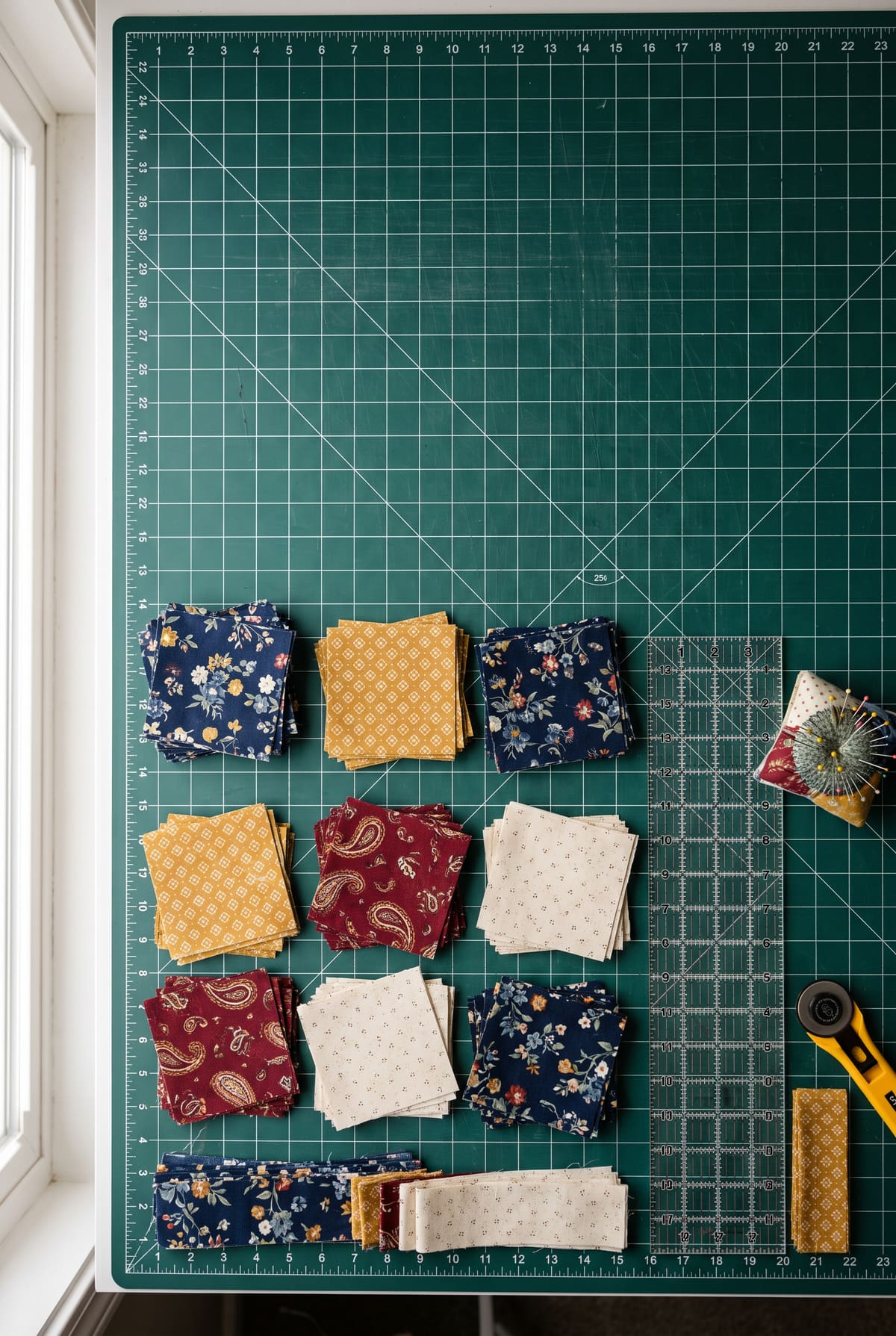
A pattern needs forty 5 inch squares from one fabric. Trimming 2 inches of selvage from 42 inch fabric leaves 40 inches, and 40 ÷ 5 = 8 squares per strip. Forty squares ÷ 8 = 5 strips, each 5 inches wide, which is 25 inches of fabric.
Twenty-five inches is 0.69 yard, so a ¾ yard cut covers it with a little to spare. With 10 percent extra the total is 27.5 inches, or 0.76 yard, so the calculator suggests ⅞ yard. The same squares would also fit in 4 fat quarters, at 12 squares each.
Yardage for common square sizes
Cut sizes, from 42 inch fabric with 40 inches usable and no extra added. Add your safety margin on top.
| Square | Per strip | 24 squares | 48 squares | 100 squares |
|---|---|---|---|---|
| 2½" | 16 | ¼ yd | ¼ yd | ½ yd |
| 3½" | 11 | ⅜ yd | ½ yd | 1 yd |
| 4½" | 8 | ⅜ yd | ¾ yd | 1⅝ yd |
| 5" | 8 | ½ yd | ⅞ yd | 1⅞ yd |
| 6½" | 6 | ¾ yd | 1½ yd | 3⅛ yd |
| 10" | 4 | 1¾ yd | 3⅜ yd | 7 yd |
How many squares from a yard of fabric
Turn the question around and the same strip method tells you what a yard holds. Pieces per strip times the whole strips in 36 inches gives the count. The 42" column uses 40 usable inches. The 60" column is for wider fabric, with the same 2 inch selvage trim.
| Square | Per strip | Strips per yard | Per yard, 42" | Per fat quarter | Per yard, 60" |
|---|---|---|---|---|---|
| 2½" | 16 | 14 | 224 | 56 | 322 |
| 3½" | 11 | 10 | 110 | 30 | 160 |
| 4½" | 8 | 8 | 64 | 16 | 96 |
| 5" | 8 | 7 | 56 | 12 | 77 |
| 6½" | 6 | 5 | 30 | 6 | 40 |
| 10" | 4 | 3 | 12 | 2 | 15 |
The table counts 56 five inch squares and 224 squares at 2½ inches per yard of 42" cotton. Neither figure allows for shrinkage or straightening the cut edge, which is why the calculator adds 10 percent by default.
Precuts in yardage
Precut bundles hold a set number of pieces, so you can work out how much yardage would replace one. The counts below come from the Stitchin' Heaven precut chart. The yardage is the calculator's, from 42" fabric with nothing extra added.
| Precut | What is in it | Strips to cut | Same pieces from yardage |
|---|---|---|---|
| Charm pack | about 42 squares, 5" | 6 | ⅞ yd |
| Layer cake | about 42 squares, 10" | 11 | 3⅛ yd |
| Jelly roll | about 40 strips, 2½" wide | 40 | 2⅞ yd |
Yardage gives you one print, while a precut bundle gives you many coordinated prints. So this is about quantity: if a pattern asks for a charm pack and you want to use one fabric instead, buy at least that much.
Fabric width changes the count
Quilting cotton is sold 42 to 44 inches wide, and those two inches can matter. One hundred 4½ inch squares fit 8 to a strip from 42" fabric, so they need 13 strips and 1⅝ yards. From 44" fabric, 9 fit across, so 12 strips and 1½ yards do the job. Measure your fabric from selvage to selvage and type the real width into the calculator.
Yard fractions in inches and centimeters
Fabric is sold by the yard, and shops cut it in fractions of a yard. A cut is always the full width of the bolt, so a quarter yard of 42" cotton is a 9 by 42 inch piece.
| Yards | Inches | Centimeters |
|---|---|---|
| ⅛ yd | 4½" | 11.4 cm |
| ¼ yd | 9" | 22.9 cm |
| ⅜ yd | 13½" | 34.3 cm |
| ½ yd | 18" | 45.7 cm |
| ⅝ yd | 22½" | 57.1 cm |
| ¾ yd | 27" | 68.6 cm |
| ⅞ yd | 31½" | 80.0 cm |
| 1 yd | 36" | 91.4 cm |
Tips for buying and cutting
- Measure your fabric before cutting. Some bolts are wider than 42 inches, and an extra piece per strip can save a strip or two.
- If you prewash, buy the extra. Cotton can shrink a few percent in length and width.
- Cut the largest pieces first, then use leftover strip ends for smaller pieces of the same fabric.
- Fat quarters suit small pieces and scrappy quilts. For strips longer than 21 inches, buy yardage.