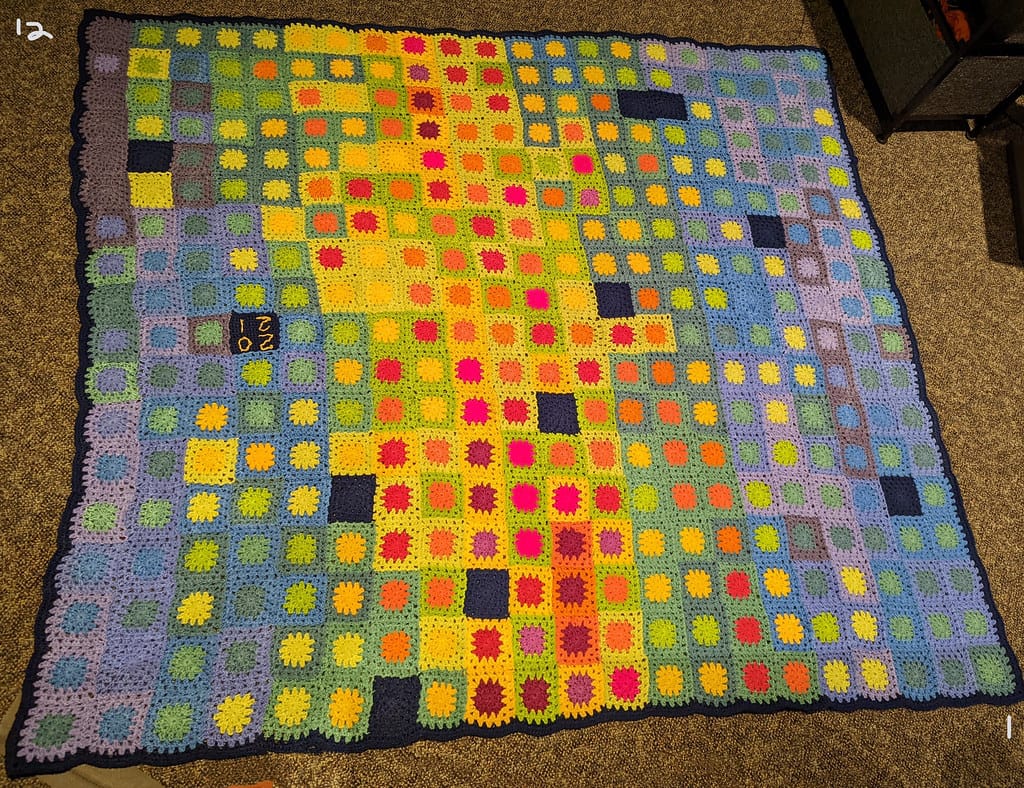
How to plan your temperature blanket
- Choose the year and whether you think in Fahrenheit or Celsius.
- Tap the climate closest to yours, then change the coldest and warmest numbers to match the extremes you normally get. Your local weather service's records are a good place to check.
- Pick how many colors you want. The planner splits the range evenly and gives each band a color, cold on the left and warm on the right. Tap any color to match the yarn you actually have.
- Choose a row a day or a square a day and enter the size, so the planner can show how big the finished blanket will be.
- Download the free tracker, print it, and fill in each day's temperature as the year goes on.
How the color ranges are worked out
The planner takes every whole degree from your coldest to your warmest temperature and divides them into equal bands, one per color. The first band also covers anything colder than your minimum, and the last band covers anything hotter than your maximum, so an unusual day always has a color.
For example, 15°F to 95°F is 81 whole degrees. Split into 10 colors, each band covers about 8 degrees:
| Color | Temperature range |
|---|---|
| Color 1 | 22°F and below |
| Color 2 | 23 to 30°F |
| Color 3 | 31 to 38°F |
| Color 4 | 39 to 46°F |
| Color 5 | 47 to 55°F |
| Color 6 | 56 to 63°F |
| Color 7 | 64 to 71°F |
| Color 8 | 72 to 79°F |
| Color 9 | 80 to 87°F |
| Color 10 | 88°F and above |
Finished size and yarn
For a row-a-day blanket, the length is the number of days times the height of one row. Measure the height of a few rows in your swatch and divide to get one row. The planner works out yarn from your swatch: how much yarn goes into a square inch of your fabric, multiplied by the area of the blanket, plus a safety margin.
For a square-a-day blanket, the planner lays out one square per day across the width you choose. It also tells you how many extra filler squares you need to finish the last row.
Formulas
- Band width = (warmest − coldest + 1) ÷ number of colors.
- Length, rows = days × row height.
- Rows of squares = days ÷ squares across, rounded up.
- Yarn = blanket area × (swatch yarn ÷ swatch area) × (1 + extra %).
How many colors for your temperature blanket
The number of colors sets how wide each band is. Over the same 15°F to 95°F spread (81 whole degrees), the planner gives these steps.
- 8 colors: about 10.1 degrees per color.
- 10 colors: about 8.1 degrees per color.
- 12 colors: about 6.8 degrees per color.
- 14 colors: about 5.8 degrees per color.
Narrow bands make day to day changes show up more, but every extra color is one more skein to buy and keep track of. If most of your days fall in a small part of the range, you can also narrow the coldest and warmest numbers instead of adding colors.
Sources give different counts. The planner at temperature-blanket.com says a typical project uses 7 to 15 colors. TL Yarn Crafts says makers choose between 5 and 12. This planner allows 4 to 14.
Pad your range for unusual days
Normal highs and lows leave out the odd heat wave or cold snap. TL Yarn Crafts took a city's average range of 19°F to 86°F and added 10 degrees at each end, so the blanket ran from 9°F to 96°F. Here is what that does with 9 colors in this planner.
- Without padding, the range is 19 to 86°F. The bands are 26°F and below, 27 to 33°F, 34 to 41°F, 42 to 48°F, 49 to 56°F, 57 to 63°F, 64 to 71°F, 72 to 78°F, 79°F and above.
- With padding, the range is 9 to 96°F. The bands are 18°F and below, 19 to 28°F, 29 to 37°F, 38 to 47°F, 48 to 57°F, 58 to 67°F, 68 to 76°F, 77 to 86°F, 87°F and above.
Padding widens every band by a couple of degrees. It also means the first and last colors only show up on truly unusual days, so you buy less of them. The planner already gives the end colors everything beyond the range, so no day goes without a color either way.
Blanket length by row height
A row-a-day blanket gets long fast, and the row height decides how long. These lengths are for 2027 (365 days) at 50 inches wide. The yarn uses the planner's default swatch of 15 yards in a 4 inch square, plus 15 percent.
| One day's row | Finished length | Yarn | 200 yd skeins |
|---|---|---|---|
| 0.2" | 73" (6.1 ft) | 3,936 yd | 20 |
| 0.25" | 91" (7.6 ft) | 4,919 yd | 25 |
| 0.33" | 120" (10.0 ft) | 6,494 yd | 33 |
| 0.5" | 183" (15.2 ft) | 9,838 yd | 50 |
Two rows a day (one for the high and one for the low) at a quarter inch each is the same as the half inch row: about 15 feet long. That is longer than a king bed. If that is too long, use a shorter stitch, a thinner yarn or a square a day.
Square-a-day layouts
With one square per day, the number of squares across sets the shape. The planner counts the filler squares you need to complete the last row. These layouts use 4 inch squares for 2027.
| Squares across | Rows of squares | Filler squares | Finished size |
|---|---|---|---|
| 15 | 25 | 10 | 60" × 100" |
| 19 | 20 | 15 | 76" × 80" |
| 21 | 18 | 13 | 84" × 72" |
| 25 | 15 | 10 | 100" × 60" |
For a granny square layout with joins and a border, the granny square calculator handles the count and color plan.
Starting points by climate
These are rough ranges to start from, not records for any one place. Always check the real coldest and warmest days where you live.
| Climate | Starting range |
|---|---|
| Cold winters | -10 to 95°F |
| Mild / temperate | 15 to 95°F |
| Warm | 35 to 105°F |
| Tropical | 60 to 100°F |
Tips for a year-long project
- Buy a little of every color at the start, then top up the colors you use most as the year goes on. Dye lots can change, so note the lot number on your tracker.
- Catch up weekly if daily is too much. Past temperatures are easy to find, so missing a few days is fine.
- Keep a printed tracker with the blanket. It also gives you a record of the year's temperatures if you make another one.
- Decide the rules before January 1st: high or low, rounding, and what you'll do for days you travel.