Needlepoint free course
Learn cross stitch and needlepoint: a free course for beginners
Updated by Khokhar Sab
To learn cross stitch, start with a small kit on 14-count Aida: under 50 × 50 stitches, a few colors and full crosses only. Stitch with 2 strands of floss and a size 24 tapestry needle, from the center of the chart outward. Once that feels easy, move to needlepoint on 13 mesh canvas with a tent stitch.
How long it takes to learn cross stitch and needlepoint
This course starts with cross stitch and moves on to needlepoint. Both use a blunt tapestry needle and a grid, so the first skills carry over. The lessons link to the guides and calculators on this site. Three short lessons sit on this page, where the site has no guide yet. Tick each lesson off as you go. Your progress stays in this browser.
The basic stitch takes minutes to learn. Caterpillar Cross Stitch says counting from a chart becomes second nature within an hour. It suggests a first design under 50 × 50 stitches, small enough to finish in a sitting or two.
Needlepoint covers the whole canvas, so a piece takes longer. Morgan Julia Designs puts it at about 1 hour per square inch on 18 mesh. That makes a 4 inch square about 16 hours on 18 mesh. On 13 mesh the same square has 2,704 stitches instead of 5,184. If time follows the stitch count, that is about 8 hours.
What you need to start
A kit holds everything for one design. If you buy the parts yourself, these are the starting points that the sources below suggest.
| Supply | Cross stitch | Needlepoint |
|---|---|---|
| Base | 14-count Aida, in white or cream | 13 mesh canvas |
| Needle | Size 24 tapestry needle | Size 18 or 20 tapestry needle |
| Thread | Six-strand cotton floss, stitched with 2 strands | Cotton, wool or silk |
| Thread length | About 18 inches | About 18 inches |
| Holder | A 4 to 6 inch hoop | Stretcher bars the size of the canvas |
| Also | Small sharp scissors | Small sharp scissors |
Caterpillar Cross Stitch gives the Aida, needle and hoop sizes, and says white or cream fabric makes counting easiest. Stitched Modern cuts floss about 18 inches long, and Morgan Julia Designs uses the same length for needlepoint thread. Needlepoint.com says beginners often start on 13 mesh because the holes are larger. On needle size the two needlepoint sources differ: Needlepoint.com uses size 18 for 13 mesh, and Morgan Julia Designs size 20.
For the first project below, one skein of floss covers about 1,770 full stitches on 14-count Aida with 2 strands, by the floss calculator. That is plenty for each color of a small sampler.
The lessons
0 of 12 done
Cross stitch or needlepoint: which to start with
Fabric or canvas, floss or wool, a hoop or stretcher bars, and how much of the surface each craft covers.
Choose a first kit or pattern
Counted or printed, how big, how many colors, and what a good kit includes for each craft.
Practice: Pick one design under 50 × 50 stitches with no more than seven colors.
Choose cross-stitch fabric
Aida, evenweave and linen, what the count means and why 14-count Aida suits a first piece.
Work out the finished size
Turn a chart's stitch count into inches on any fabric, and see how much fabric to cut.
Practice: Enter your chart's width and height in stitches and note the fabric size for 14-count Aida.
Work out how much floss you need
How many skeins each color takes, from the stitch count, the fabric and the strands.
Use a hoop or frame
How to put fabric in a hoop, when a Q-snap or scroll frame helps, and how to mount canvas on stretcher bars.
Practice: Hoop your fabric with the center in the middle of the hoop, then tap it. It should feel taut.
Make your first cross stitches
Reading the chart, strands and needle size, the loop start and stitching your first row.
Practice: Stitch a row of ten crosses with every top stitch slanting the same way.
Keep the back tidy
How to start, end and move threads so the back stays flat and nothing shows through the front.
Backstitch outlines and French knots
Reading backstitch lines on a chart, working them neatly and making French knots that stay put.
Wash, press and frame your piece
Testing colors, washing and pressing the finished piece, and mounting it in a frame.
Choose a needlepoint canvas
Mono, interlock and Penelope canvas, mesh sizes, and painted or printed designs.
Learn the needlepoint stitches
Half cross, continental and basketweave: three ways to work a tent stitch and where each one suits.
Practice: Work a 1 inch square of basketweave on scrap canvas before you start your design.
Lesson 2: choose a first kit or pattern
A kit takes the early choices off your hands. Caterpillar Cross Stitch says a good one includes Aida, pre-sorted floss, a tapestry needle, a printed chart and clear instructions. Not every kit includes a hoop, so check before you buy.
Cross-stitch kits come in two kinds.
- Counted. Blank Aida and a separate chart. You count squares on the chart to place each stitch.
- Printed, or stamped. The design is printed on the fabric and you stitch over it, with no counting.
Caterpillar Cross Stitch calls both beginner friendly. It adds that counted kits give a cleaner finish and build the counting habit that every later chart needs. Its tips for a first design are these.
- Keep it small. Under about 50 × 50 stitches, which fits a 4 to 6 inch hoop.
- Watch the colors. Three to seven colors keeps it manageable.
- Use full stitches only. Leave part stitches and French knots for a later piece.
- Pick a design you like. You are more likely to finish it.
For needlepoint, Morgan Julia Designs suggests a 13 mesh canvas with bold blocks of color and little fine detail. Needlepoint.com also says to start small, with only a few colors. It suggests coasters, ornaments, key fobs and luggage tags as first projects.
Lesson 6: use a hoop or frame
A hoop or frame holds the fabric taut so your stitches come out even. Stitched Modern says using one is up to you, but beginners may find a hoop easier. It puts fabric in a hoop like this.
- Loosen the screw and separate the two rings.
- Lay the ring without the screw flat on the table.
- Lay the fabric over it, with the center of the fabric in the center of the hoop.
- Press the outer ring down over the fabric.
- Pull the fabric gently taut as you tighten the screw. Stop before the weave distorts.
Sirious Stitches compares the main holders. A hoop is light and easy to hold, but the tension loosens as you work, and it can leave creases. A Q-snap frame clips on and off and leaves no crease marks. A scroll frame suits large, long projects. You can also stitch in hand, without any frame, if you keep the tension even yourself.
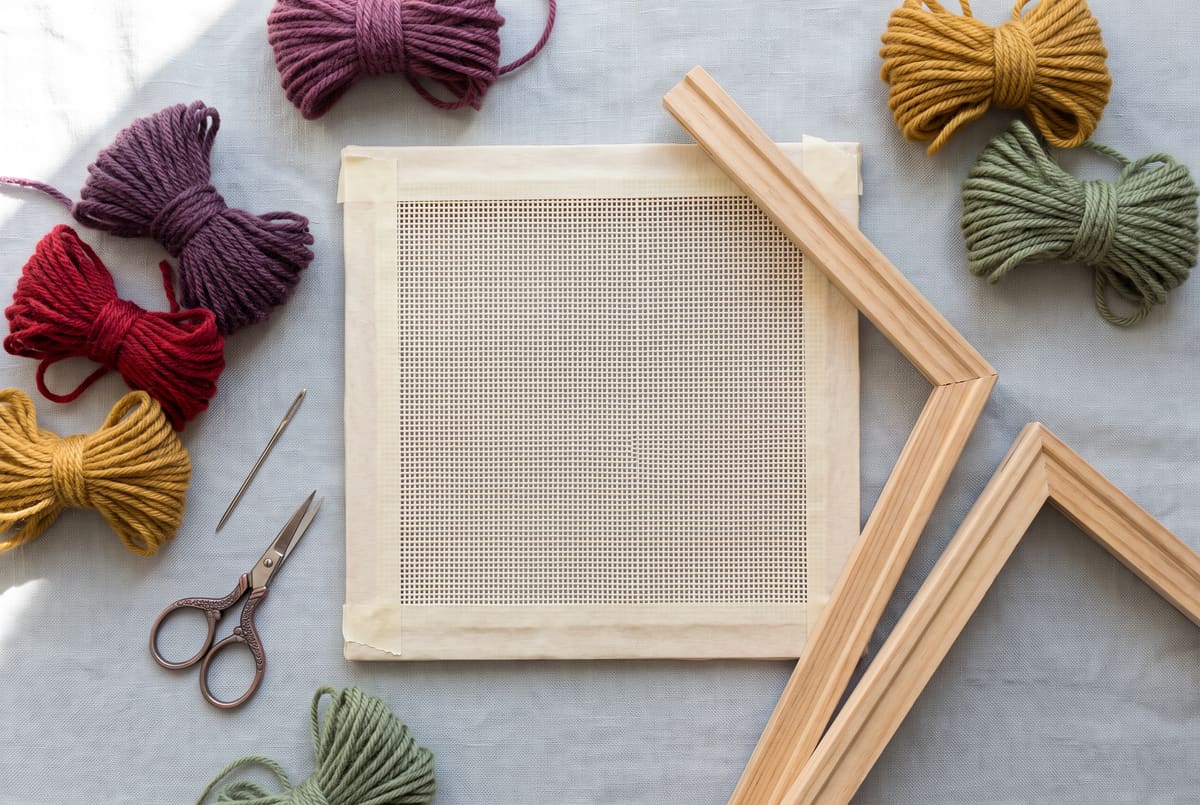
Needlepoint canvas goes on stretcher bars, wooden bars that slot together into a frame. Needlepoint.com calls them a personal preference and says they keep the canvas taut and reduce warping. Buy one pair for the width and one for the length. Stitch Society gives an example: an 8 × 10 inch canvas needs an 8 inch pair and a 10 inch pair. Tack the canvas to the bars from the center of each side outward. Stitch Society warns that pulling it too tight distorts the grid.
Lesson 8: keep the back tidy
Long or loose threads behind the fabric can show through the front or catch on things. These habits keep the back flat and neat.
- Start without a knot. Stitched Modern leaves about an inch of tail on the back and covers it with the first stitches. A knot leaves a lump. The beginner's guide also shows the loop start.
- Avoid long jumps. Stitched Modern says long threads across the back may show through the front. If the next area is more than a few stitches away, end the thread and start again there.
- Travel under stitches. For a short move, Mary Corbet of Needle 'n Thread runs the thread under the backs of nearby stitches. Loose carried threads can snag.
- End threads securely. Stitched Modern passes the needle under at least three finished stitches, then trims.
On needlepoint canvas, Morgan Julia Designs stitches the light colors first. Fibers from dark threads can cling to light ones and leave a visible tint.
Needlepoint for beginners: moving from cross stitch to canvas
Needlepoint uses the same needle and the same kind of chart, but three things change.
- The stitch. Morgan Julia Designs describes the tent stitch as a small diagonal stitch over one canvas intersection. The needlepoint stitches guide explains the three ways to work it.
- Coverage. The stitches cover the whole canvas, background included, so a piece has more stitches than a cross-stitch design of the same size.
- The design. Morgan Julia Designs says most canvases come with the design painted on, so you match thread to the paint instead of counting.
Needlepoint.com starts in the upper right corner of a large area of one color. It recommends basketweave wherever possible, because it keeps the canvas from warping. It also says to use a light touch, since pulling too tight distorts the canvas. Size your canvas with the canvas size calculator before you buy.
Practice projects: a sampler, then a coaster
First, a cross-stitch sampler. Choose a 50 × 50 stitch design with a few colors. On 14-count Aida it comes out 3.6 inches square. With 2 inches of bare fabric on every side, cut the Aida 8 × 8 inches. A bookmark is another good first piece. At 30 × 100 stitches it measures 2.1 × 7.1 inches on the same fabric.
- Find the center of the fabric and the chart, and start there.
- Stitch with 2 strands and keep every top stitch slanting the same way.
- Add any backstitch outlines last.
- Wash, press and frame it, or finish it in the hoop.
Then, a needlepoint coaster. A 4 inch square on 13 mesh is 52 × 52 stitches, 2,704 in all. The canvas size calculator adds 3 inches on every side, so buy a 10 × 10 inch canvas and two pairs of 10 inch stretcher bars. Work the background in basketweave and the small areas in continental stitch.
Common beginner mistakes
- Starting too big. A large design with many colors is hard to finish. Start under 50 × 50 stitches.
- Mixed stitch directions. Caterpillar Cross Stitch says every top diagonal should face the same way. This one habit makes work look neat.
- Pulling too tight. Stitched Modern says stitches should lie flat without pulling the fabric. Needlepoint.com warns that tight stitches distort canvas.
- Long jumps on the back. End the thread and start again instead.
- Using a sharp needle. Caterpillar Cross Stitch says a blunt tapestry needle slides between the threads instead of piercing them.
- Buying floss a little at a time. Stitched Modern buys all the thread at the start, because dye lots can vary.
- Reusing unpicked thread. Morgan Julia Designs does not reuse it, since the fiber has worn.
Frequently asked questions
How long does it take to learn cross stitch?
Caterpillar Cross Stitch says counting from a chart becomes second nature within an hour. It also says a design under 50 × 50 stitches can be finished in a sitting or two. A 50 × 50 design holds up to 2,500 stitches.
Is cross stitch or needlepoint easier for beginners?
Sources differ. Caterpillar Cross Stitch calls both counted and printed cross stitch kits beginner friendly. Morgan Julia Designs says the needlepoint canvas grid makes it easier to learn and more forgiving. The cross stitch vs needlepoint guide compares the two in detail.
Do I need a hoop to cross stitch?
No. Stitched Modern says whether you use one is up to you, but beginners may find a hoop easier. Sirious Stitches notes that stitching in hand works if you keep the tension even yourself.
What size needle do I need for needlepoint?
It depends on the mesh, and sources differ. Needlepoint.com uses a size 18 tapestry needle for 13 mesh and size 22 for 18 mesh. Morgan Julia Designs suggests size 20 for 13 mesh and size 22 for 18 mesh. Most kits include the right needle.
Can you wash needlepoint like cross stitch?
Morgan Julia Designs says needlepoint is not washer friendly. Cross stitch can be washed gently once you test the colors, as the framing guide explains.
Sources and further reading
- Caterpillar Cross Stitch: how to choose your first beginner cross stitch kit.
- Stitched Modern: a beginner's guide to cross stitch.
- Sirious Stitches: hoop, Q-snap or scroll frame.
- Needlepoint.com: starting your needlepoint journey.
- Morgan Julia Designs: how to learn needlepoint.
Video tutorial
"Easy beginner cross stitch guide ✨ 🪡 🩵 Step by step tutorial" by Colorfully Sarah, on YouTube. The video loads only when you press play.