Knitting free course
Learn to knit: a free beginner course
Updated by Khokhar Sab
To learn to knit, buy smooth medium (weight 4) yarn and a pair of 4.5 to 5 mm needles. Cast on 24 to 30 stitches for a 6 inch swatch. Learn the knit stitch, then the purl stitch, then stockinette, and practice picking up a dropped stitch. Bind off, then learn gauge and finishing. Your first real project can be a hat in the round, with socks as the next step.
How long it takes to learn to knit
Knitting builds fabric from rows of loops held on a needle. All the stitches in the current row stay live on the needle until you knit them.
Sources differ on how fast it goes. Bob Vila says new knitters can learn the basics in a few hours. Sheep and Stitch warns that you probably won't get the knit stitch on your first or second try, and says the key is to keep trying.
This course has 12 lessons. Four of them teach the stitches on this page. The rest link to full guides on this site, and the last one is a real project.
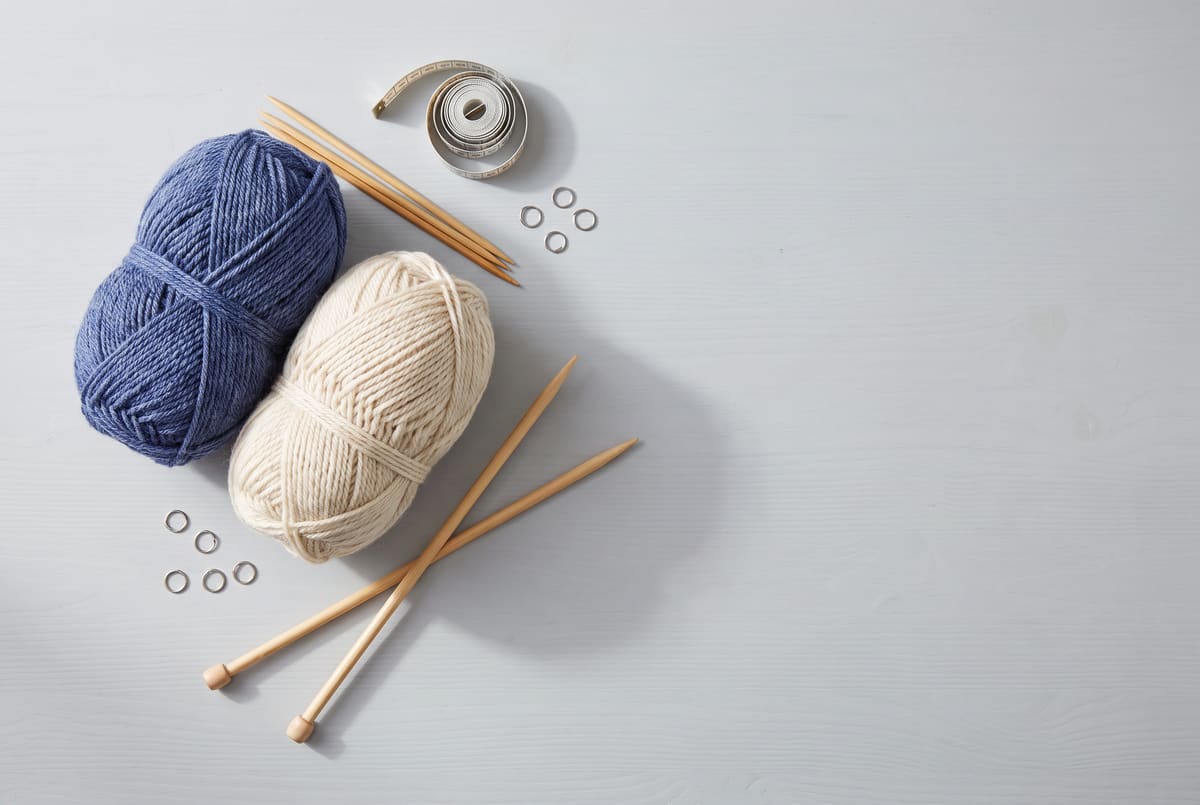
Knitting for beginners: what you need to start
You need one ball of yarn and one pair of needles. Bob Vila adds scissors, a crochet hook for rescuing dropped stitches and a darning needle for weaving in ends.
- Yarn. Bob Vila calls medium-weight yarn ideal for beginners. Medium is weight 4 on the label, also called worsted. The Craft Yarn Council expects 16 to 20 stitches in 4 inches with it. Sheep and Stitch suggests cheap acrylic so that mistakes don't feel costly.
- Needles. Bob Vila suggests US 6 to 8, or 4 to 5 mm. The Craft Yarn Council pairs worsted yarn with 4.5 to 5.5 mm needles (US 7 to 9). Sheep and Stitch prefers wood or bamboo, since its grip stops stitches sliding off.
Some teachers start beginners on thicker yarn. Sheep and Stitch uses chunky yarn on 9 mm needles because it is easier to grip, and Clover's beginner lesson uses super bulky yarn on a 10 mm needle. The knitting needle size chart converts metric, US and UK sizes. The guide to types of yarn compares wool, cotton and acrylic.
How many stitches to cast on for a practice swatch
This course uses a practice swatch about 6 inches wide. The table runs that width through the long-tail cast-on calculator at both ends of the Craft Yarn Council gauge range for three beginner weights. The tail is the calculator's rough estimate from needle size, plus 6 inches for weaving in.
| Yarn weight | Gauge per 4 in | Needle used | Stitches to cast on | Long tail to leave |
|---|---|---|---|---|
| 4 Medium | 16 to 20 stitches | 5 mm | 24 to 30 | About 28 to 34 in |
| 5 Bulky | 12 to 15 stitches | 6.5 mm | 18 to 23 | About 28 to 34 in |
| 6 Super bulky | 7 to 11 stitches | 9 mm | 11 to 17 | About 24 to 34 in |
The needle sizes sit inside the Council's range for each weight. If your yarn label gives a gauge, use that instead.
The lessons
0 of 12 done
Cast on
Put the first row of loops on the needle. The long-tail cast-on is the usual first method.
Practice: Cast on the count for your yarn from the swatch table on this page.
The knit stitch
The first of the two basic stitches. Knitting every stitch of every row already makes a usable fabric.
Practice: Knit 10 rows. Count your stitches at the end of each row.
The purl stitch
The knit stitch worked from the other side, with the yarn in front.
Practice: Purl 4 rows on the same swatch.
Garter and stockinette stitch
How knit and purl rows combine into the two fabrics beginner patterns use, and how to tell them apart.
Practice: Work 10 rows of stockinette: knit one row, purl the next.
Fix a dropped stitch
Catch a stitch that slid off the needle before it runs down the fabric, and pick it back up.
Practice: Drop one stitch on purpose, let it run 3 rows and pick it back up.
Bind off
Take the stitches off the needle so the edge can't unravel. Includes stretchy bind-offs for cuffs and hats.
Practice: Bind off your swatch and weave in both tails.
Yarn weights and fibers
What the numbers 0 to 7 on a label mean, and which needle each weight wants.
Measure your gauge
Count stitches and rows in 4 inches of a swatch, and change needle size until it matches the pattern.
Increase evenly
The arithmetic behind a pattern line like "increase 12 stitches evenly across".
Pick up stitches
Add new stitches along an edge, for necklines, button bands and sock gussets.
Block your knitting
Wet, steam or spray a finished piece so the stitches even out and it dries to the right size.
Your first project
Knit a hat in the round, then move on to socks.
Lesson 2: the knit stitch
Hold the needle with the stitches in your left hand and the empty needle in your right. Bob Vila describes a pencil grip and a knife grip for the needles, so use whichever feels relaxed. In the English style, the right hand carries the yarn. Bob Vila weaves it over the index finger, under the middle, over the ring finger and under the pinky. These steps follow Bob Vila and Clover.
- Keep the working yarn at the back of the work.
- Insert the right needle into the first stitch on the left needle, from front to back. The needles cross in an X, with the right needle behind.
- Wrap the working yarn counterclockwise around the right needle.
- Pull the right needle, with the new loop on it, back through the old stitch.
- Slide the old stitch off the left needle. One knit stitch is done, and it sits on the right needle.
- Repeat across the row. Then swap the needles between your hands and start the next row.
Lesson 3: the purl stitch
The purl stitch is the knit stitch done backwards. These steps follow Sheep and Stitch and Bob Vila.
- Bring the working yarn to the front of the work.
- Insert the right needle into the first stitch from back to front, so its tip points toward you.
- Wrap the yarn around the right needle from front to back.
- Pull the new loop down and back through the stitch.
- Slide the old stitch off the left needle.
Yarn position is the difference between the two stitches. The yarn sits at the back to knit and in front to purl. When a row mixes knits and purls, the yarn moves between the needle tips each time you switch.
Lesson 4: garter vs stockinette stitch
Sheep and Stitch sums up the two stitches: "knits are Vs and purls are bumps." The two beginner fabrics come from how you combine them.
| Fabric | How to work it flat | What it looks like |
|---|---|---|
| Garter stitch | Knit every stitch of every row. | Ridges of bumps on both sides, the same front and back. |
| Stockinette stitch | Knit one row, purl the next, and repeat. | Smooth columns of Vs on the front, bumps on the back. |
Garter looks the same on both sides because each purl bump is the back of a knit stitch. Sheep and Stitch explains that knitting every row flat puts a knit row and a purl row on each face in turn. Worked in the round, stockinette means knitting every stitch, because the right side always faces you. The hat and sock guides in the practice project both work it that way.
Lesson 5: fixing a dropped stitch
Sheep and Stitch describes a dropped stitch as one that falls off the needle. It leaves a ladder of loose strands as it runs down the rows. Catch it fast and slip a spare needle through it so it can't run further. Bob Vila fixes it with a crochet hook on the knit side.
- Knit to the spot where the stitch dropped.
- Insert the crochet hook into the dropped loop from front to back.
- Find the loose strand of yarn directly above the loop. Catch it with the hook and pull it through the loop.
- Repeat with the next strand up, one row at a time, until no strands are left.
- Put the loop back on the left needle and knit on.
Sheep and Stitch shows the same fix with a spare double-pointed needle in place of the hook. You lift the stitch over each strand, row by row, until it reaches the main needle.
Your first knitting project
Once the swatch looks even, put the lessons to work on a real piece.
- A hat. The guide to knitting a hat covers a beginner beanie in the round, with cast-on counts for every size, ribbing and crown decreases. It uses the knit and purl stitches from this course, plus a short circular needle.
- Socks, as a next step. The guide to knitting socks adds a heel flap, a heel turn, picked-up gusset stitches and a grafted toe. The pick-up lesson above prepares you for the gusset.
The knitting gauge calculator turns your swatch into stitch counts for either project.
Common beginner mistakes
Sheep and Stitch lists these problems for new knitters.
- Dropped stitches. They show as a run down the fabric with a loose stitch at the bottom. Lesson 5 fixes them.
- Knitting too tightly. If you can barely get the needle into the stitches, push each new stitch onto the thick part of the needle before you tighten it. Sheep and Stitch also suggests going up a needle size, in 0.5 mm steps.
- Extra stitches and holes. These come from accidental yarn overs, which add a loop and leave a hole. Count your stitches at the end of each row.
Frequently asked questions
How long does it take to learn to knit?
Bob Vila says new knitters can learn the basics in a few hours. Sheep and Stitch is more cautious and expects the knit stitch to take a few tries.
What size knitting needles should a beginner use?
Bob Vila suggests US 6 to 8, which is 4 to 5 mm, with medium (weight 4) yarn. Sheep and Stitch suggests chunky yarn on 9 mm needles, which is easier to grip. Match the needle to your yarn label. The knitting needle size chart converts metric, US and UK sizes.
Can you teach yourself to knit?
Yes. Bob Vila says anyone can learn from the free guides and videos online. This course puts the steps in order, from casting on to a finished hat.
Should I learn to knit or crochet first?
Either works as a first craft. Knitting makes the thin, stretchy fabric that suits hats, socks and sweaters. The knit vs crochet guide compares the two, and the free crochet course follows the same plan as this one.
What is the easiest thing to knit first?
Bob Vila lists coasters, pot holders and scarves, since flat squares and rectangles need no shaping. In this course, a hat in the round comes next, since it adds ribbing, decreases and finishing.
Sources and further reading
- Bob Vila, How to Knit for Beginners: 6 Key Stitches to Know.
- Sheep and Stitch, How to Purl Stitch in Knitting.
- Sheep and Stitch, How to Fix a Dropped Stitch.
- Clover, Beginner Knitting: Casting On, Knit, and Purl Stitches.
- Craft Yarn Council, Hooks and Needles.
Supplies and beginner mistakes also come from Sheep and Stitch's How to Knit for Beginners guide.
Video tutorial
"How to Knit: Easy for Beginners" by RJ Knits, on YouTube. The video loads only when you press play.